Benchmarks#
How nind compares with other indexers when it is used as an index plus BM25 top-k search:
Lucene (through Anserini), tantivy and bm25s, on the same tokens, the same BM25
parameters (k1 = 1.2, b = 0.75) and the same machine, from 3,600 documents to 138 million passages.
nind 4.3.2, measured on a 48-thread server from 2026-11-05 to 2026-11-20. nind’s results are a3f44c6’s (format v3 term indexes, after 4.3.2), measured on 2026-11-19 and 20; Lucene’s, tantivy’s and bm25s’s are from 2026-11-05 to 13. The laptop results this page
showed before are kept at the end.
In short
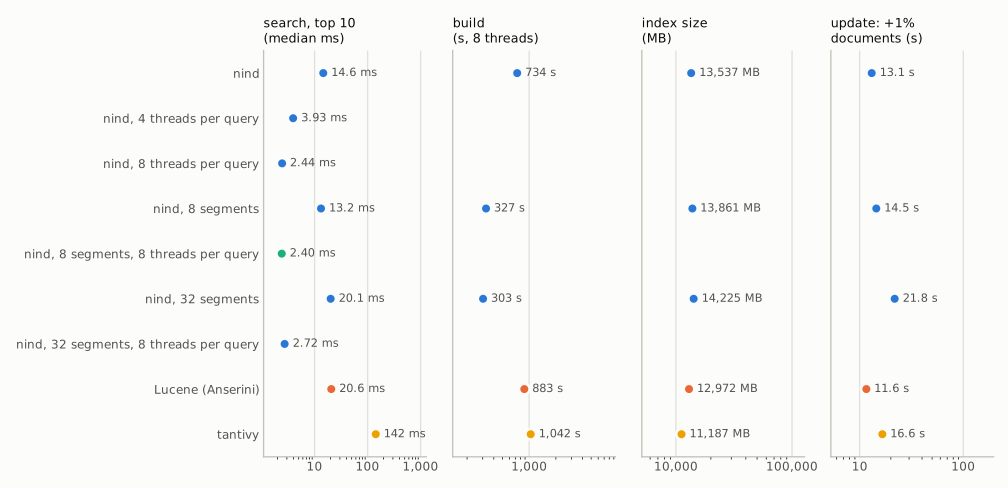
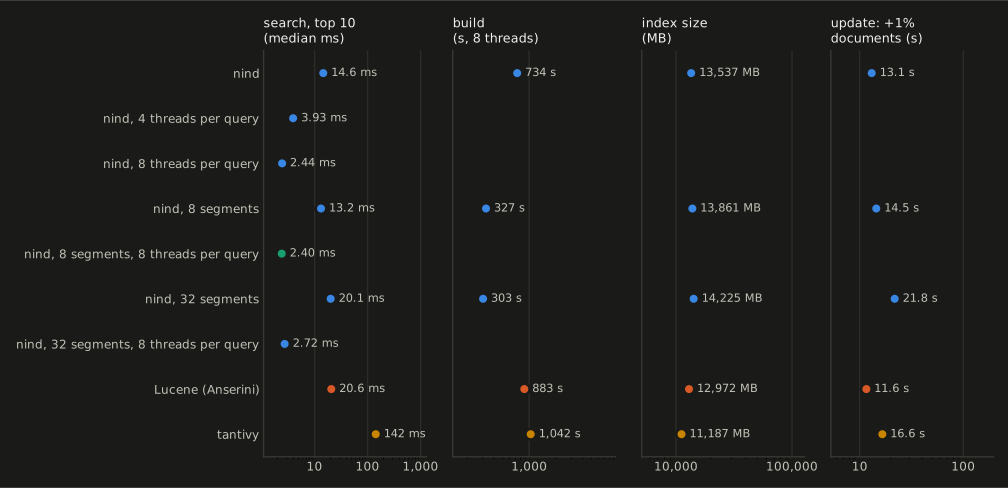
Search, 138 million passages (MS MARCO v2). One query’s top 10 takes 14.6 ms on one thread (median), against 20.6 ms for Lucene (tantivy 142 ms). An index of 8 segments searched with 8 threads per query takes 2.40 ms. 99th percentile: 213 ms on one thread (Lucene 237 ms), 26.6 ms with 8 segments and 8 threads.
Search, 8.8 million passages (MS MARCO). 2.24 ms on one thread (Lucene 2.93 ms, tantivy 10.0 ms), 0.477 ms with 8 segments and 8 threads.
Stopwords kept: very long postings lists (a term in most of the passages). At 138M, 22.3 ms on one thread against 36.1 ms for Lucene; 3.76 ms with 8 segments and 8 threads.
Many callers at once, every system: at 8.8M nind serves the most at every load (2,567 queries/s with 12 callers, Lucene 2,065; 4,847 with 48, Lucene’s threads 2,574). At 138M nind leads with few callers and Lucene with many (786 queries/s with 48 callers, nind 519).
Index larger than memory. With 1 GB of page cache for a 14 GB index, nind’s top 10 goes from 16.6 to 31.4 ms, Lucene’s from 20.1 to 103 ms; nind holds 1.48 GB of its own (lengths, cached term directories), Lucene 1.23 GB.
Indexing. 138M passages in 303 s in 32 segments (Lucene 883 s, tantivy 1,042 s, 8 threads each), 230 s with 48 threads; one index: 734 s and 41 GB of memory. 8.8M passages: 21.2 s in 32 segments, 49.2 s for one index (Lucene 67.8 s).
Updates. Adding 1% more documents writes a new segment: 1.05 s at 8.8M (Lucene 3.53 s, tantivy 1.25 s), 13.1 s at 138M (Lucene 11.6 s, tantivy 16.6 s).
Long documents (MS MARCO v2.1, 10.96M web pages of 1,191 tokens on average): top 10 on one thread 3.22 ms for nind, 3.86 ms for Lucene, 81.6 ms for tantivy; top 1000 16.6 ms against 36.9; 8 segments with 8 threads 1.00 ms.
Quality. The same BM25: nDCG@10 0.222 for nind and 0.222 for Lucene at 8.8M, 0.0790 and 0.0808 at 138M; every nind layout returns the same top 10.
Search latency as the corpus grows#
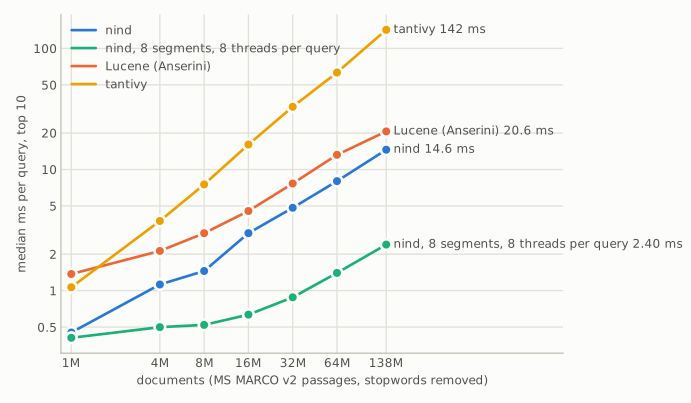
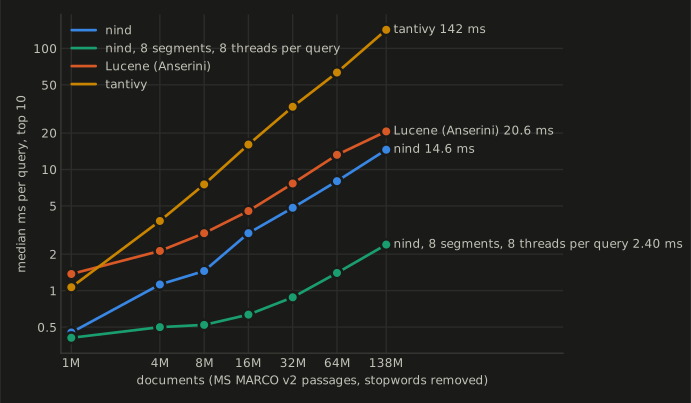
Median time per query to get the 10 best documents, one query at a time: prefixes of MS MARCO v2 (stopwords removed), its 3,903 dev queries. nind uses block-max MaxScore: only the blocks of postings that may reach the top 10 are read. Up to 64M passages nind is faster than Lucene on one thread; at 138M they are even. With 8 segments and 8 threads per query, each thread searches a segment, with the same results.
system |
1M |
4M |
8M |
16M |
32M |
64M |
138M |
|---|---|---|---|---|---|---|---|
nind |
0.451 ms |
1.12 ms |
1.45 ms |
2.98 ms |
4.83 ms |
8.02 ms |
14.6 ms |
nind, 8 threads per query |
0.364 ms |
0.301 ms |
0.416 ms |
0.576 ms |
0.872 ms |
1.35 ms |
2.44 ms |
nind, 8 segments, 8 threads per query |
0.408 ms |
0.499 ms |
0.521 ms |
0.633 ms |
0.880 ms |
1.40 ms |
2.40 ms |
nind, 32 segments, 8 threads per query |
0.602 ms |
0.895 ms |
0.829 ms |
0.906 ms |
1.17 ms |
1.65 ms |
2.72 ms |
Lucene (Anserini) |
1.37 ms |
2.13 ms |
2.98 ms |
4.54 ms |
7.67 ms |
13.2 ms |
20.6 ms |
tantivy |
1.07 ms |
3.76 ms |
7.53 ms |
16.1 ms |
33.0 ms |
63.2 ms |
142 ms |
MS MARCO v2, 138 million passages#
system |
top 10, median |
top 10, 99th pct |
top 100, median |
top 1000, median |
build |
build memory |
index |
update +1% |
nDCG@10 |
|---|---|---|---|---|---|---|---|---|---|
nind |
14.6 ms |
213 ms |
25.0 ms |
47.7 ms |
734 s |
42,167 MB |
13,537 MB |
13.1 s |
0.079 |
nind, 4 threads per query |
3.93 ms |
45.9 ms |
7.28 ms |
16.8 ms |
– |
– |
– |
– |
0.079 |
nind, 8 threads per query |
2.44 ms |
27.5 ms |
4.63 ms |
11.1 ms |
– |
– |
– |
– |
0.079 |
nind, 8 segments |
13.2 ms |
186 ms |
24.1 ms |
49.1 ms |
327 s |
38,724 MB |
13,861 MB |
14.5 s |
0.079 |
nind, 8 segments, 8 threads per query |
2.40 ms |
26.6 ms |
4.59 ms |
10.6 ms |
– |
– |
– |
– |
0.079 |
nind, 32 segments |
20.1 ms |
248 ms |
37.9 ms |
82.2 ms |
303 s |
11,497 MB |
14,225 MB |
21.8 s |
0.079 |
nind, 32 segments, 8 threads per query |
2.72 ms |
26.8 ms |
5.05 ms |
11.6 ms |
– |
– |
– |
– |
0.079 |
Lucene (Anserini) |
20.6 ms |
237 ms |
40.3 ms |
75.5 ms |
883 s |
26,503 MB |
12,972 MB |
11.6 s |
0.081 |
tantivy |
142 ms |
728 ms |
142 ms |
157 ms |
1,042 s |
4,682 MB |
11,187 MB |
16.6 s |
0.079 |
Stopwords kept (Lucene’s 33 English stopwords are otherwise removed): frequent terms have very long postings lists (a term in most of the 138M passages). Not updated.
system |
top 10, median |
top 10, 99th pct |
top 100, median |
top 1000, median |
build |
build memory |
index |
update +1% |
nDCG@10 |
|---|---|---|---|---|---|---|---|---|---|
nind |
22.3 ms |
263 ms |
38.2 ms |
81.0 ms |
893 s |
55,310 MB |
14,621 MB |
– |
0.077 |
nind, 8 threads per query |
3.82 ms |
37.3 ms |
7.69 ms |
19.4 ms |
– |
– |
– |
– |
0.077 |
nind, 8 segments |
25.8 ms |
277 ms |
47.6 ms |
107 ms |
366 s |
54,579 MB |
14,945 MB |
– |
0.077 |
nind, 8 segments, 8 threads per query |
3.76 ms |
33.3 ms |
7.41 ms |
18.3 ms |
– |
– |
– |
– |
0.077 |
Lucene (Anserini) |
36.1 ms |
328 ms |
64.2 ms |
134 ms |
870 s |
27,336 MB |
13,905 MB |
– |
0.080 |
tantivy |
1,096 ms |
2,491 ms |
1,098 ms |
1,110 ms |
1,113 s |
4,590 MB |
12,173 MB |
– |
0.078 |
The relevance judgments of MS MARCO v2’s dev queries are sparse (about one passage per query), hence the
low nDCG@10 for every system. The top 10 of Lucene and nind overlap at 0.993 (tantivy
0.980). verify_index read back every definition of the one-index and 8-segment builds without error
(4.0G postings; 5.2G with stopwords).
Long documents: MS MARCO v2.1, 10.96 million web pages#
TREC RAG 2024’s corpus: web pages (url, title, headings and body, as Anserini indexes them), 1,191 tokens each on average once stopwords are removed (34 for a v2 passage), 13.1G tokens in all, the longest 241,543. The dev queries (4,552), one pass of warm-up, two measured; stopwords removed.
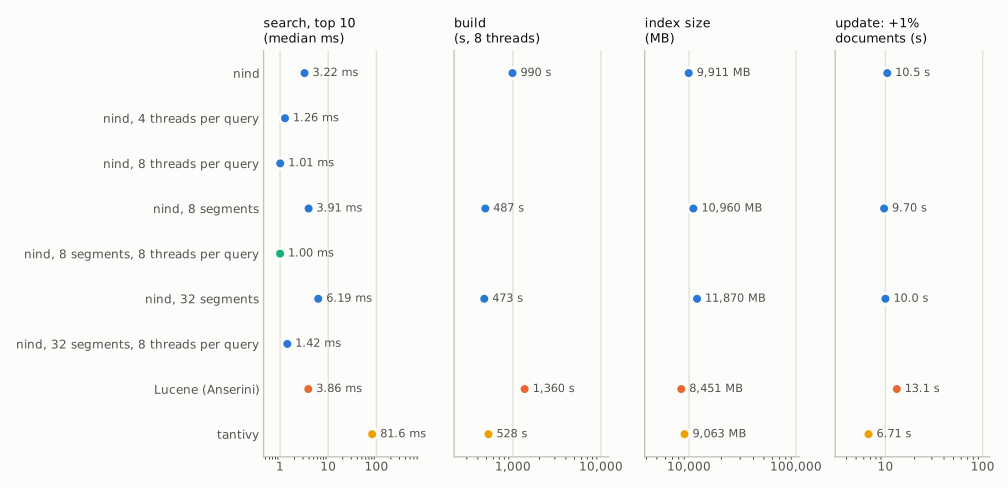
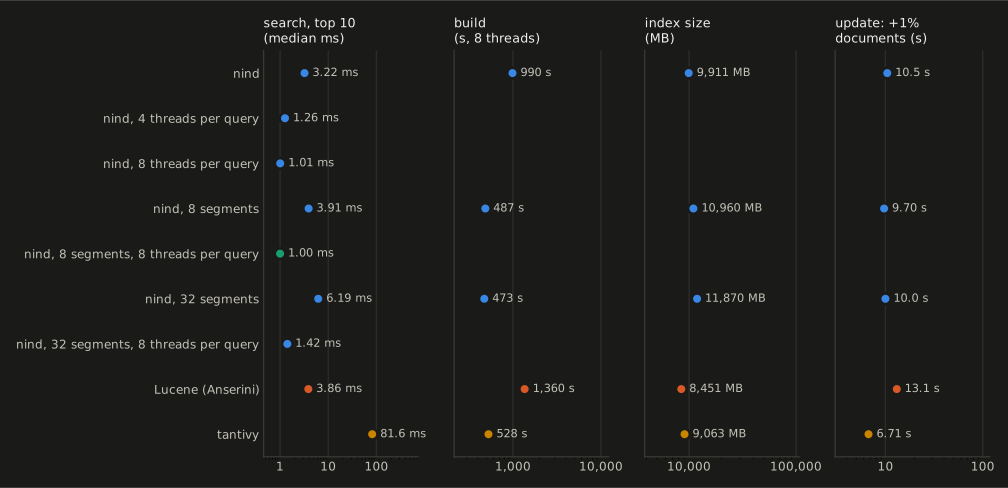
system |
top 10, median |
top 10, 99th pct |
top 100, median |
top 1000, median |
build |
build memory |
index |
update +1% |
nDCG@10 |
|---|---|---|---|---|---|---|---|---|---|
nind |
3.22 ms |
34.7 ms |
6.34 ms |
16.6 ms |
990 s |
55,212 MB |
9,911 MB |
10.5 s |
0.225 |
nind, 4 threads per query |
1.26 ms |
9.48 ms |
2.85 ms |
8.48 ms |
– |
– |
– |
– |
0.225 |
nind, 8 threads per query |
1.01 ms |
6.84 ms |
2.12 ms |
6.89 ms |
– |
– |
– |
– |
0.225 |
nind, 8 segments |
3.91 ms |
42.1 ms |
8.31 ms |
22.8 ms |
487 s |
51,036 MB |
10,960 MB |
9.70 s |
0.225 |
nind, 8 segments, 8 threads per query |
1.00 ms |
6.40 ms |
2.05 ms |
6.45 ms |
– |
– |
– |
– |
0.225 |
nind, 32 segments |
6.19 ms |
60.9 ms |
13.7 ms |
38.2 ms |
473 s |
15,632 MB |
11,870 MB |
10.0 s |
0.225 |
nind, 32 segments, 8 threads per query |
1.42 ms |
7.09 ms |
2.56 ms |
7.26 ms |
– |
– |
– |
– |
0.225 |
Lucene (Anserini) |
3.86 ms |
36.5 ms |
8.92 ms |
36.9 ms |
1,360 s |
20,929 MB |
8,451 MB |
13.1 s |
0.224 |
tantivy |
81.6 ms |
224 ms |
82.6 ms |
92.8 ms |
528 s |
4,742 MB |
9,063 MB |
6.71 s |
0.224 |
As the corpus grows (top 10, median):
system |
1M |
4M |
11M |
|---|---|---|---|
nind |
0.805 ms |
1.91 ms |
3.22 ms |
nind, 8 threads per query |
0.419 ms |
0.871 ms |
1.01 ms |
nind, 8 segments, 8 threads per query |
0.411 ms |
0.666 ms |
1.00 ms |
nind, 32 segments, 8 threads per query |
0.912 ms |
0.890 ms |
1.42 ms |
Lucene (Anserini) |
1.33 ms |
2.19 ms |
3.86 ms |
tantivy |
7.26 ms |
28.9 ms |
81.6 ms |
Stopwords kept (17.2G tokens). Not updated.
system |
top 10, median |
top 10, 99th pct |
top 100, median |
top 1000, median |
build |
build memory |
index |
update +1% |
nDCG@10 |
|---|---|---|---|---|---|---|---|---|---|
nind |
4.42 ms |
46.2 ms |
9.89 ms |
27.0 ms |
1,018 s |
58,374 MB |
10,219 MB |
– |
0.226 |
nind, 8 threads per query |
1.24 ms |
7.16 ms |
2.64 ms |
8.66 ms |
– |
– |
– |
– |
0.226 |
nind, 8 segments |
6.53 ms |
58.2 ms |
13.5 ms |
37.2 ms |
683 s |
46,962 MB |
11,268 MB |
– |
0.226 |
nind, 8 segments, 8 threads per query |
1.28 ms |
6.84 ms |
2.63 ms |
8.47 ms |
– |
– |
– |
– |
0.226 |
Lucene (Anserini) |
4.83 ms |
47.1 ms |
11.2 ms |
44.3 ms |
1,394 s |
20,750 MB |
8,724 MB |
– |
0.224 |
tantivy |
166 ms |
349 ms |
170 ms |
181 ms |
531 s |
4,736 MB |
9,386 MB |
– |
0.224 |
On one thread, nind’s top 10 takes 3.22 ms at 10.96M documents, Lucene’s 3.86 ms; its top 1000
16.6 ms against 36.9 ms; an index of 8 segments searched with 8 threads, 1.00 ms. On the
judged TREC topics below, Lucene’s top 10 is the faster one (5.36 ms against 6.31). nind’s
builds are faster and take more memory than Lucene’s (54 GB for one index without local index, Lucene
20 GB), its index more space (9.9 GB against 8.5: its term index, in
format v3 since a3f44c6, and its lexicon; see docs/proposals/format-v3.md). The first update of its 32-segment index writes one segment (10.0 s;
it merged 9.8M documents, in 1,689 s, before merges were limited by their term index’s bytes). verify_index read back every definition of the one-index and 8-segment builds (39.3M terms,
4.8G postings; 5.1G with stopwords).
The judged TREC Deep Learning 2021-2023 topics (215), nDCG@10, with our BM25 parameters and with Anserini’s defaults (k1 = 0.9, b = 0.4):
system |
k1 = 1.2, b = 0.75 |
k1 = 0.9, b = 0.4 |
stopwords kept, 1.2 / 0.75 |
top 10, median |
|---|---|---|---|---|
nind |
0.3654 |
0.3526 |
0.3627 |
6.31 ms |
nind, 8 segments |
0.3654 |
0.3526 |
0.3627 |
7.37 ms |
nind, 32 segments |
0.3654 |
0.3526 |
– |
9.96 ms |
Lucene (Anserini) |
0.3665 |
0.3514 |
0.3618 |
5.36 ms |
tantivy |
0.3666 |
– |
0.3618 |
101 ms |
Anserini’s published runs on this corpus, which stem with Porter, give nDCG@10 0.354 (DL21 0.5183, DL22 0.2991, DL23 0.2914) over the same topics: the harness’s Lucene agrees with it, and every system ranks alike (top 10 overlap with nind 0.968).
MS MARCO, 8.8 million passages#
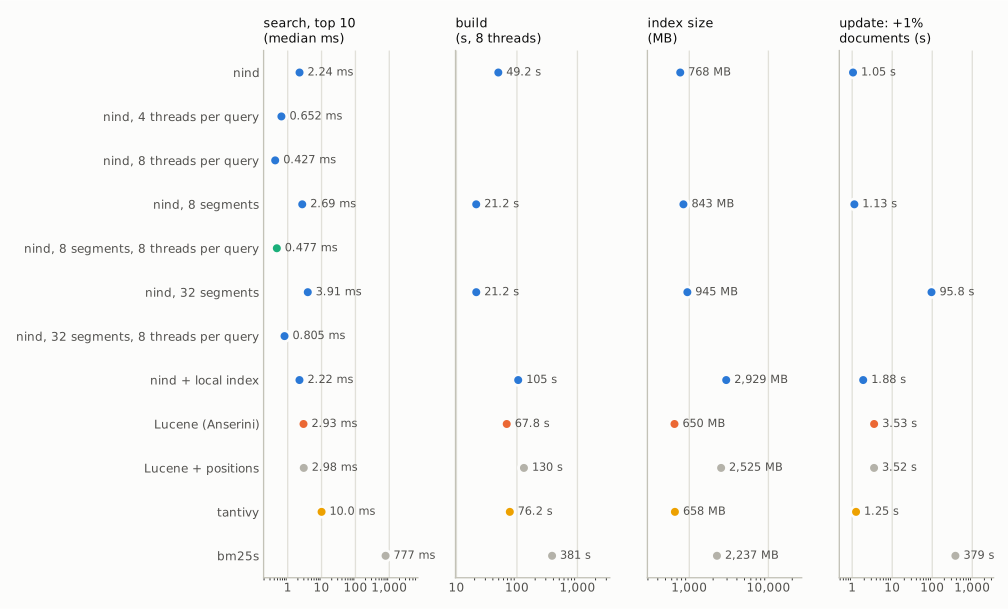
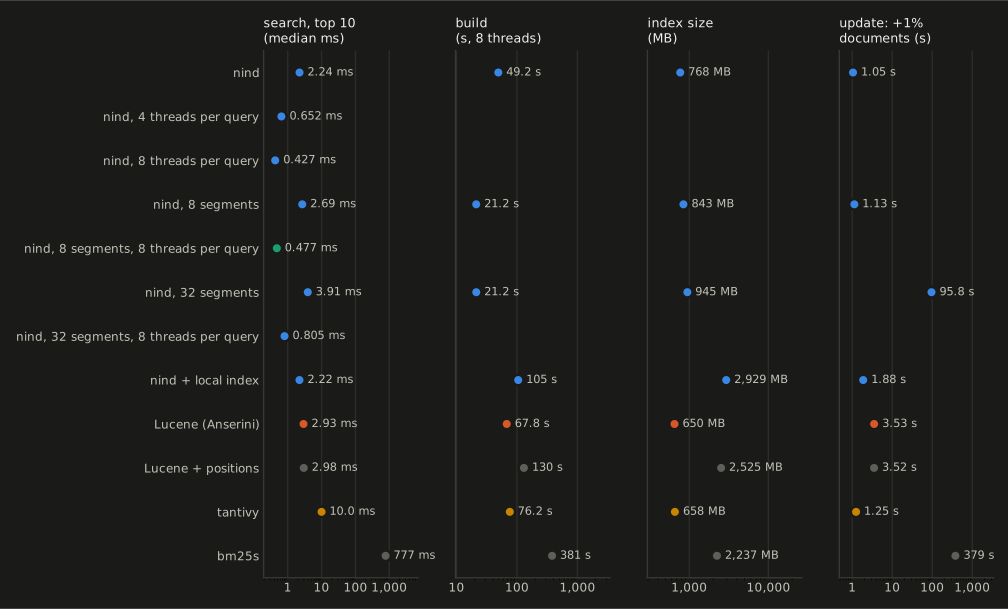
system |
top 10, median |
top 10, 99th pct |
top 100, median |
top 1000, median |
build |
build memory |
index |
update +1% |
nDCG@10 |
|---|---|---|---|---|---|---|---|---|---|
nind |
2.24 ms |
22.8 ms |
4.33 ms |
9.82 ms |
49.2 s |
3,782 MB |
768 MB |
1.05 s |
0.222 |
nind, 4 threads per query |
0.652 ms |
5.05 ms |
1.51 ms |
3.96 ms |
– |
– |
– |
– |
0.222 |
nind, 8 threads per query |
0.427 ms |
2.92 ms |
1.06 ms |
5.41 ms |
– |
– |
– |
– |
0.222 |
nind, 8 segments |
2.69 ms |
26.9 ms |
5.88 ms |
13.2 ms |
21.2 s |
3,974 MB |
843 MB |
1.13 s |
0.222 |
nind, 8 segments, 8 threads per query |
0.477 ms |
2.97 ms |
1.09 ms |
3.26 ms |
– |
– |
– |
– |
0.222 |
nind, 32 segments |
3.91 ms |
36.0 ms |
8.75 ms |
18.6 ms |
21.2 s |
1,701 MB |
945 MB |
95.8 s |
0.222 |
nind, 32 segments, 8 threads per query |
0.805 ms |
4.01 ms |
1.45 ms |
4.13 ms |
– |
– |
– |
– |
0.222 |
nind + local index |
2.22 ms |
22.1 ms |
4.31 ms |
9.77 ms |
105 s |
3,313 MB |
2,929 MB |
1.88 s |
0.222 |
Lucene (Anserini) |
2.93 ms |
21.6 ms |
6.73 ms |
27.6 ms |
67.8 s |
3,220 MB |
650 MB |
3.53 s |
0.222 |
Lucene + positions |
2.98 ms |
22.7 ms |
6.94 ms |
24.1 ms |
130 s |
8,988 MB |
2,525 MB |
3.52 s |
0.222 |
tantivy |
10.0 ms |
65.4 ms |
10.7 ms |
17.2 ms |
76.2 s |
1,434 MB |
658 MB |
1.25 s |
0.222 |
bm25s |
777 ms |
976 ms |
778 ms |
777 ms |
381 s |
13,681 MB |
2,237 MB |
379 s |
0.228 |
Stopwords kept:
system |
top 10, median |
top 10, 99th pct |
top 100, median |
top 1000, median |
build |
build memory |
index |
update +1% |
nDCG@10 |
|---|---|---|---|---|---|---|---|---|---|
nind |
3.24 ms |
28.6 ms |
7.02 ms |
18.8 ms |
63.6 s |
4,770 MB |
848 MB |
1.26 s |
0.222 |
nind, 4 threads per query |
1.000 ms |
6.63 ms |
2.60 ms |
8.06 ms |
– |
– |
– |
– |
0.222 |
nind, 8 threads per query |
0.693 ms |
3.76 ms |
1.90 ms |
6.60 ms |
– |
– |
– |
– |
0.222 |
nind, 8 segments |
4.11 ms |
36.3 ms |
10.2 ms |
26.8 ms |
28.3 s |
4,818 MB |
922 MB |
1.25 s |
0.222 |
nind, 8 segments, 8 threads per query |
0.774 ms |
3.87 ms |
1.95 ms |
6.38 ms |
– |
– |
– |
– |
0.222 |
nind, 32 segments |
6.04 ms |
49.5 ms |
15.7 ms |
45.1 ms |
26.5 s |
2,000 MB |
1,025 MB |
109 s |
0.222 |
nind, 32 segments, 8 threads per query |
1.20 ms |
5.20 ms |
2.52 ms |
7.61 ms |
– |
– |
– |
– |
0.222 |
nind + local index |
3.32 ms |
29.1 ms |
7.23 ms |
19.1 ms |
142 s |
4,364 MB |
3,674 MB |
2.35 s |
0.222 |
Lucene (Anserini) |
4.02 ms |
29.0 ms |
8.99 ms |
32.0 ms |
73.7 s |
3,954 MB |
716 MB |
3.85 s |
0.222 |
Lucene + positions |
4.19 ms |
30.4 ms |
9.31 ms |
28.6 ms |
146 s |
8,131 MB |
3,080 MB |
4.24 s |
0.222 |
tantivy |
72.9 ms |
201 ms |
74.1 ms |
83.0 ms |
80.2 s |
1,458 MB |
740 MB |
1.34 s |
0.221 |
bm25s |
193 ms |
1,445 ms |
194 ms |
186 ms |
473 s |
17,876 MB |
2,853 MB |
474 s |
0.226 |
bm25s: the first 500 queries (it scores every document), hence its different nDCG@10.
Threads#
Threads per query, one query at a time (NindEngine.search(..., threads=t)): median ms, top 10.
Up to 12 threads on one socket’s physical cores, 16 and 24 on both sockets’, 48 on every hardware
thread (here and below). Each run is a process of its own (see “Separate processes vary” below:
2.10 ms here for the 2.66 ms of the table above).
index |
1 |
2 |
4 |
8 |
12 |
16 |
24 |
|---|---|---|---|---|---|---|---|
8.8M, one index |
2.10 |
1.46 |
0.835 |
0.566 |
0.892 |
1.44 |
1.40 |
8.8M, 8 segments |
2.38 |
1.32 |
0.782 |
0.509 |
0.507 |
0.811 |
1.04 |
8.8M, 32 segments |
4.18 |
2.47 |
1.51 |
0.762 |
0.700 |
0.965 |
1.08 |
8.8M stopwords kept, one index |
8.18 |
5.04 |
3.57 |
4.27 |
5.33 |
5.95 |
5.56 |
8.8M stopwords kept, 8 segments |
8.69 |
4.61 |
2.52 |
1.46 |
1.47 |
2.19 |
2.89 |
8.8M stopwords kept, 32 segments |
9.79 |
5.28 |
2.97 |
1.72 |
1.42 |
1.73 |
1.68 |
138M, one index |
20.8 |
11.5 |
8.08 |
10.2 |
10.6 |
11.1 |
9.82 |
138M, 8 segments |
20.6 |
9.55 |
4.78 |
2.88 |
2.84 |
4.11 |
4.97 |
138M, 32 segments |
23.5 |
10.4 |
5.24 |
3.07 |
2.65 |
2.49 |
3.66 |
138M stopwords kept, one index |
179 |
139 |
117 |
107 |
103 |
103 |
89.0 |
138M stopwords kept, 8 segments |
128 |
59.5 |
34.5 |
16.2 |
15.8 |
21.8 |
24.4 |
A single index splits its documents into ranges, one per thread; its gain stops at 8 threads at 8.8M (4 with stopwords kept) and at 4 at 138M. Segments scale further: each thread searches its own segments, sharing the top 10’s threshold. Crossing to the second socket costs more than it gives.
Many callers at once, every system: N callers, each sending its next query when the last
one returns (bench/retrieval/concurrency.py), top 10, stopwords removed; queries per second, the best
of each row in bold. Threads share one searcher (nind, Lucene through pyjnius and tantivy-py release
Python’s GIL while they search); processes each open the index, as separate servers would. Pinned as
above. Measured 2026-11-11 with nind 4.1.0’s development version (document names mapped, MaxScore by windows for 5 terms or more: docs/TODO.md).
MS MARCO 8.8M, threads:
callers |
nind |
nind, 8 segments |
Lucene (Anserini) |
tantivy |
|---|---|---|---|---|
1 |
218 |
182 |
208 |
76 |
2 |
436 |
360 |
415 |
150 |
4 |
870 |
718 |
808 |
304 |
8 |
1,727 |
1,428 |
1,590 |
603 |
12 |
2,567 |
2,105 |
2,065 |
928 |
24 |
4,350 |
3,939 |
3,144 |
1,762 |
48 |
4,847 |
4,371 |
2,574 |
1,857 |
MS MARCO v2 138M, threads:
callers |
nind |
nind, 8 segments |
Lucene (Anserini) |
tantivy |
|---|---|---|---|---|
1 |
24 |
24 |
22 |
5 |
2 |
48 |
48 |
43 |
10 |
4 |
94 |
96 |
86 |
20 |
8 |
183 |
187 |
205 |
41 |
12 |
263 |
276 |
284 |
60 |
24 |
474 |
483 |
599 |
120 |
48 |
519 |
673 |
786 |
132 |
Processes, 8.8M:
callers |
nind |
nind, 8 segments |
Lucene (Anserini) |
tantivy |
|---|---|---|---|---|
1 |
217 |
181 |
212 |
75 |
2 |
423 |
356 |
414 |
151 |
4 |
815 |
678 |
781 |
304 |
8 |
1,621 |
1,336 |
1,457 |
600 |
12 |
2,433 |
1,935 |
1,887 |
895 |
24 |
4,588 |
3,467 |
3,068 |
1,602 |
48 |
5,666 |
4,371 |
4,906 |
1,819 |
Processes, 138M:
callers |
nind |
nind, 8 segments |
Lucene (Anserini) |
tantivy |
|---|---|---|---|---|
1 |
24 |
24 |
25 |
5 |
2 |
48 |
47 |
42 |
10 |
4 |
89 |
86 |
79 |
20 |
8 |
163 |
165 |
145 |
38 |
12 |
237 |
240 |
162 |
55 |
24 |
384 |
444 |
359 |
117 |
48 |
498 |
554 |
627 |
102 |
99th percentile at 138M, threads, ms:
callers |
nind |
nind, 8 segments |
Lucene (Anserini) |
tantivy |
|---|---|---|---|---|
1 |
263 |
259 |
247 |
725 |
2 |
268 |
261 |
242 |
744 |
4 |
271 |
258 |
242 |
745 |
8 |
274 |
267 |
223 |
741 |
12 |
273 |
266 |
226 |
754 |
24 |
314 |
301 |
218 |
749 |
48 |
580 |
407 |
316 |
1,500 |
8.8M: nind serves the most at every load, threads or processes: 2,567 queries/s with 12 callers (one socket’s cores; Lucene 2,065), 4,847 with 48 threads (Lucene’s lose past the cores: 2,574), 5,666 with 48 processes (Lucene 4,906, each with its own JVM).
138M: nind leads with few callers, Lucene with many: 24 against 22 queries/s alone, 519 (8 segments: 673) against 786 with 48 threads. nind gains less from more threads on the large index (474 to 519 from 24 to 48 callers, Lucene 599 to 786; one run each: repeated twice at 48 threads, nind 634 and 642, Lucene 770 and 753,
scale-repeat.txt);docs/TODO.md. 99th percentile alone: 263 ms, Lucene’s 247 ms. (Before MaxScore scanned queries of 5 terms or more in windows, term at a time, nind served 477 with 48 threads at 138M and 4,303 at 8.8M.)Segments serve about as many queries as one index up to 24 callers (each query does the same work; they lower latency with threads per query, above), more with 48 threads at 138M (673 against 519).
Processes each run their share of the queries after their own warm-up: with many of them, few queries each (Lucene’s JVMs warm up apart), so those rows vary more.
Memory of its own per process (anonymous memory, 138M): nind 1.06 GB; nind, 8 segments 1.05 GB; Lucene (Anserini) 0.83 GB; tantivy 0.04 GB. A system that maps its index (Lucene, tantivy) shares those pages between processes, as nind shares its mapped document names; nind’s are mostly its documents’ lengths and its directory cache.
Build threads, 8.8M passages (--threads): seconds.
system |
1 |
2 |
4 |
8 |
12 |
24 |
48 |
|---|---|---|---|---|---|---|---|
nind |
131 s |
97.9 s |
80.0 s |
76.4 s |
78.2 s |
93.6 s |
124 s |
nind, 32 segments |
168 s |
95.9 s |
51.0 s |
29.1 s |
23.3 s |
16.1 s |
12.4 s |
Lucene (Anserini) |
137 s |
122 s |
73.3 s |
59.1 s |
71.9 s |
102 s |
98.6 s |
tantivy |
82.2 s |
59.2 s |
102 s |
90.2 s |
88.3 s |
152 s |
108 s |
A build in 32 segments runs its shards in parallel: it scales to every hardware thread (peak memory 0.492 GB on 1 thread, 8.53 GB on 48). One index has a single writer, so threads only tokenize. At 138M with 48 threads: nind in 32 segments 230 s (peak 106 GB), Lucene 1,241 s, tantivy 1,543 s (both slower than with 8 threads on one socket).
Index larger than memory#
MS MARCO v2, 138M passages, stopwords removed (indexes of 11 to 15 GB): each system searches in a
cgroup (systemd-run --user -p MemoryMax=...) holding its own memory (the peak of an uncapped run,
+10%) plus a budget for the page cache; the index is evicted from the cache first, so every page
it reads counts. The first 2,000 queries after a warm-up of 500; median ms.
system |
own memory |
no limit |
8 GB |
4 GB |
2 GB |
1 GB |
|---|---|---|---|---|---|---|
nind |
1.48 GB |
16.6 |
17.8 |
22.4 |
23.6 |
31.4 |
nind, 8 segments, 8 threads per query |
1.28 GB |
3.16 |
12.9 |
22.9 |
30.2 |
34.5 |
Lucene (Anserini) |
1.23 GB |
20.1 |
22.9 |
52.3 |
84.3 |
103 |
tantivy |
0.795 GB |
151 |
122 |
127 |
143 |
152 |
Top 1000, median ms:
system |
own memory |
no limit |
8 GB |
4 GB |
2 GB |
1 GB |
|---|---|---|---|---|---|---|
nind |
1.48 GB |
50.8 |
41.7 |
96.0 |
356 |
556 |
nind, 8 segments, 8 threads per query |
1.28 GB |
11.1 |
14.4 |
83.6 |
305 |
503 |
Lucene (Anserini) |
1.23 GB |
88.9 |
78.9 |
595 |
1,383 |
2,022 |
tantivy |
0.795 GB |
163 |
132 |
157 |
326 |
478 |
nind reads only what it needs: MaxScore reads a term’s blocks with positioned reads. Its top 10 goes from 16.6 ms without a limit to 31.4 ms with 1 GB (Lucene 20.1 to 103 ms).
Every search returns its hits’ names (the harness asks for them, as it has Lucene load each hit’s stored id), read in the mapped names file (4.96 GB), whose pages share the budget: a top 1000 reads a thousand names spread over it, from 50.8 ms without a limit to 556 ms with 1 GB (Lucene 88.9 to 2,022 ms).
8 segments with 8 threads per query read more per query in a few milliseconds: the disk shows, from 3.16 ms without a limit to 12.9 ms with 8 GB and 34.5 ms with 1 GB, the single thread’s time.
Lucene and tantivy map their files (
mmap): with less cache, Lucene’s top 10 gets 5× slower and its top 1000 (which loads each hit’s stored id) much more; tantivy’s top 1000 too. Readahead on mapped files is a likely cause, not investigated.nind’s own memory: 1.48 GB, the documents’ lengths (1.66 GB on disk, read compactly) and the query terms’ directories, cached (up to 1 GB,
directory_cache_mb); Lucene needs 1.23 GB and tantivy 0.795 GB. Up to 4.0.1, nind read the names and lengths whole at open: 6.98 GB of its own, outside the budget, so its runs then had the page cache to the index alone (its top 10 at 1 GB: 19.8 ms, top 1000: 48.2 ms).
Smaller corpora (BEIR)#
Every query of each dataset; stopwords removed.
dataset |
documents |
nind |
Lucene (Anserini) |
tantivy |
bm25s |
|---|---|---|---|---|---|
SciFact |
5,183 |
0.113 ms · 0.665 |
1.10 ms · 0.664 |
0.078 ms · 0.664 |
0.117 ms · 0.665 |
NFCorpus |
3,633 |
0.035 ms · 0.308 |
0.749 ms · 0.308 |
0.029 ms · 0.307 |
0.140 ms · 0.308 |
FiQA |
57,600 |
0.416 ms · 0.238 |
1.53 ms · 0.241 |
0.393 ms · 0.241 |
0.393 ms · 0.238 |
Each cell: median top-10 latency · nDCG@10.
How to read these numbers#
Latency is measured per query, one at a time: the median of every dev query (3,903 for MS MARCO v2, 6,980 for v1), the 99th percentile for the slowest. Runs are pinned to one socket’s 12 physical cores with its memory (
numactl); the corpus is evicted from the page cache and the index read once before searching; a warm-up (200 queries at 8.8M, a whole pass on v2), then 3 measured passes at 8.8M (the median shown; they differ by a few percent), one on v2’s prefixes and with stopwords kept, 2 at 138M.Threads per query have no counterpart for the others here. Lucene can also split a query (an
IndexSearcherwith an executor, over its segments); Anserini’s searcher, used here, doesn’t.Segments are what
index_jsonl(shards=N)and updates leave (docs/proposals/segments.md): a build of N shards in parallel, searched as one index with the same results. The first update of a 32-segment build merges a tier of them at 8.8M (95.8 s); at 138M segments that large are left alone.Lucene is called from Python (pyjnius): its top-1000 latency mostly measures building one Java object per hit, so the top 10 and top 100 compare best.
nind + local index also stores each document’s terms and positions (as Amose reads them): larger and slower to build, the same search.
bm25s precomputes every score: fast on small corpora, not built for millions of documents (left out at 138M).
Separate processes vary. The same search in a new process sometimes runs about 20% faster (2.1 instead of 2.7 ms at 8.8M), for reasons not found yet; the passes of one process agree.
Server: 2 × Intel Xeon Gold 5317 (12 cores, 24 hardware threads, one memory node each), 251 GB of memory, SATA SSDs, Linux 5.14, Java 21. Builds use 8 threads unless said otherwise.
Earlier results: laptop#
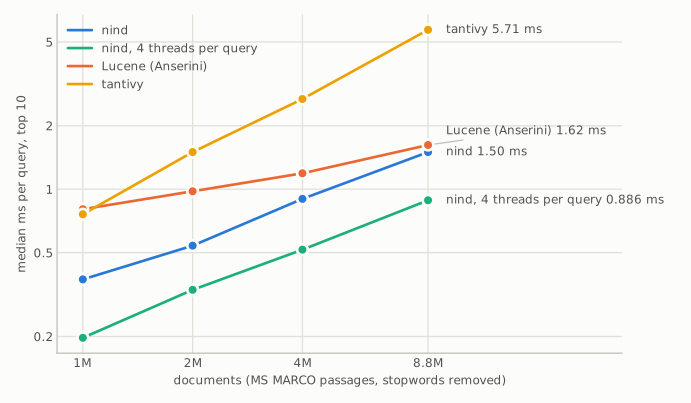
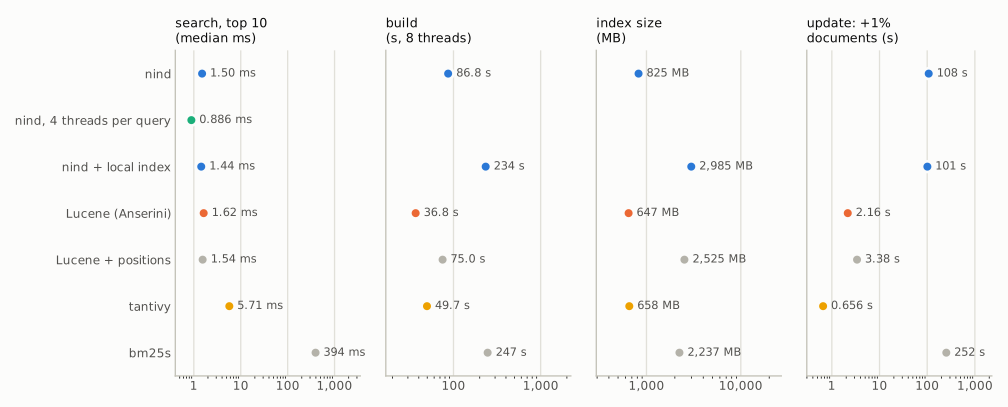
nind 3.2.0 on 2026-11-05, the other systems on 2026-11-04: a 14-core laptop-class processor (8 fast and 6 efficient cores), 62 GB of memory, MS MARCO v1 only, 500 queries per size (hence a different nDCG@10), unpinned. The ratios mostly match the server’s; absolute times are lower there (faster cores).
system |
1M |
2M |
4M |
8.8M |
|---|---|---|---|---|
nind |
0.373 ms |
0.540 ms |
0.900 ms |
1.50 ms |
nind, 4 threads per query |
0.197 ms |
0.333 ms |
0.517 ms |
0.886 ms |
Lucene (Anserini) |
0.804 ms |
0.978 ms |
1.19 ms |
1.62 ms |
tantivy |
0.761 ms |
1.50 ms |
2.68 ms |
5.71 ms |
system |
top 10, median |
top 10, 99th pct |
top 1000, median |
build |
build memory |
index |
update +1% |
nDCG@10 |
|---|---|---|---|---|---|---|---|---|
nind |
1.50 ms |
26.6 ms |
6.36 ms |
86.8 s |
7,797 MB |
825 MB |
108 s |
0.228 |
nind, 4 threads per query |
0.886 ms |
11.1 ms |
3.79 ms |
– |
– |
– |
– |
0.228 |
nind + local index |
1.44 ms |
31.0 ms |
6.16 ms |
234 s |
8,206 MB |
2,985 MB |
101 s |
0.228 |
Lucene (Anserini) |
1.62 ms |
13.1 ms |
16.0 ms |
36.8 s |
3,439 MB |
647 MB |
2.16 s |
0.227 |
Lucene + positions |
1.54 ms |
11.5 ms |
15.4 ms |
75.0 s |
5,638 MB |
2,525 MB |
3.38 s |
0.227 |
tantivy |
5.71 ms |
29.6 ms |
9.39 ms |
49.7 s |
1,447 MB |
658 MB |
0.656 s |
0.227 |
bm25s |
394 ms |
508 ms |
349 ms |
247 s |
14,003 MB |
2,237 MB |
252 s |
0.228 |
Stopwords kept:
system |
top 10, median |
top 10, 99th pct |
top 1000, median |
build |
build memory |
index |
update +1% |
nDCG@10 |
|---|---|---|---|---|---|---|---|---|
nind |
4.45 ms |
45.2 ms |
13.6 ms |
131 s |
10,507 MB |
915 MB |
121 s |
0.226 |
nind, 4 threads per query |
2.43 ms |
21.8 ms |
9.03 ms |
– |
– |
– |
– |
0.226 |
nind + local index |
4.59 ms |
52.4 ms |
14.4 ms |
357 s |
10,900 MB |
3,741 MB |
111 s |
0.226 |
Lucene (Anserini) |
2.40 ms |
16.9 ms |
20.3 ms |
52.8 s |
3,438 MB |
709 MB |
3.47 s |
0.228 |
Lucene + positions |
2.41 ms |
19.9 ms |
22.1 ms |
106 s |
5,459 MB |
3,058 MB |
4.33 s |
0.228 |
tantivy |
41.1 ms |
108 ms |
46.2 ms |
55.1 s |
1,481 MB |
739 MB |
0.850 s |
0.227 |
bm25s |
49.7 ms |
429 ms |
47.5 ms |
413 s |
18,153 MB |
2,853 MB |
341 s |
0.226 |
BEIR:
dataset |
documents |
nind |
Lucene (Anserini) |
tantivy |
bm25s |
|---|---|---|---|---|---|
SciFact |
5,183 |
0.066 ms · 0.665 |
0.646 ms · 0.664 |
0.053 ms · 0.664 |
0.081 ms · 0.665 |
NFCorpus |
3,633 |
0.023 ms · 0.308 |
0.561 ms · 0.308 |
0.018 ms · 0.307 |
0.092 ms · 0.308 |
FiQA |
57,600 |
0.493 ms · 0.238 |
0.803 ms · 0.241 |
0.308 ms · 0.241 |
0.248 ms · 0.238 |
Each cell: median top-10 latency · nDCG@10.
nind’s update numbers there are those of an index written in place (before segments): a first update after a build rewrote every term it touched.
Reproduce#
The scripts are in bench/retrieval/ (see bench/README.md, sections 4 and 7): prepare.py writes
the tokenized corpora, driver.py builds, searches and updates every system and writes
report.csv, concurrency.py measures throughput, and site.py writes this page from them. The
server runs’ raw results and scripts are in bench/retrieval/results/2026-11-10-server/, with nind’s
later runs in 2026-11-11-server/ (several callers) and 2026-11-12-server/ (the rest).